
Introduction
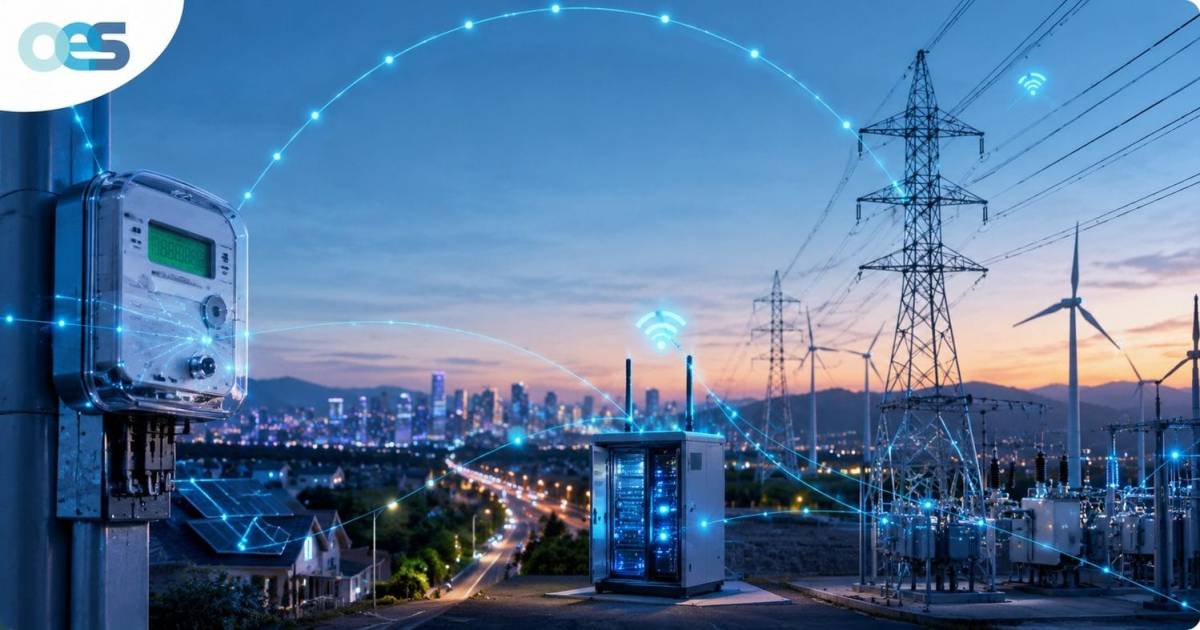
India’s energy sector is undergoing a significant transformation through the large-scale deployment of smart meters under the Revamped Distribution Sector Scheme (RDSS). While smart meters are often seen as the face of this modernization effort, the real enabler is the smart meter communication system that connects them to utility networks. A robust smart meter communication system allows utilities to collect real-time consumption data, perform remote meter operations, detect outages faster, and improve billing accuracy. Without reliable communication, even the most advanced smart meter cannot deliver its intended benefits.
As millions of smart meters are deployed across diverse urban and rural environments, communication challenges such as network coverage, signal interference, interoperability, and cybersecurity become increasingly important. Addressing these challenges is critical to ensuring seamless connectivity and operational efficiency.
Ultimately, the success of India’s smart metering mission depends not only on deploying meters but also on building a secure, scalable, and resilient smart meter communication system that can support the country’s future-ready digital power infrastructure.
At Omkaar Energy we are working on this problem.
This article will explain how these communication systems work what technology is important and why and what we have learned from working on this project. We will talk about Indias energy sector and smart meters. How they can be used to make the energy grid better.
What a Smart Meter Communication System Actually Does
A Smart Meter Communication System is what helps move information between meters and the systems that utilities use. It does this automatically so people do not have to go out and read the meters by hand. This system is always. Receiving information, which is different from the old way of doing things.
The old way is called Automatic Meter Reading, which’s usually only one way. This means that information is only sent one way from the meter to the utility.. A Smart Meter Communication System is like Advanced Metering Infrastructure, which can send and receive information. This means that utilities can read meters from away turn service on and off from far away update the meters and even get alerts if something goes wrong. They can do all of this without having to send someone out to the meter.
The system has a few parts that all work together. There is the meter itself the network that carries the information the concentrators that collect all the information and the head-end system that manages everything. Each of these parts can. If one part fails the whole system can fail. So the system is only as good, as its part. A Smart Meter Communication System has to be reliable. It will not work properly.
Why This Matters More Now Than It Did Five Years Ago
Traditional distribution networks were built for one-way power flow with almost no real-time visibility. That model is breaking down under the weight of rising demand, distributed renewable generation, and DISCOMs under mounting pressure to cut AT&C losses. The problems utilities are dealing with today are specific and expensive:
- Grid instability from uncoordinated renewable integration
- Energy theft and technical losses that manual reading can’t catch in time
- Aging infrastructure with limited fault visibility
- High operational cost per meter read
- Rising demand outpacing planning cycles
A working Smart Meter Communication System addresses these directly — not as a nice-to-have dashboard, but as the mechanism that lets a DISCOM detect an outage before a customer calls it in, flag tamper events automatically, and stop paying for manual meter-reading rounds. This is why communication reliability, not meter accuracy alone, has become the deciding factor in RDSS deployment success.
Architecture: The Four Layers That Have to Work Together
1. The Smart Meter Layer
The meter captures consumption data, voltage and current measurements, power quality data, event logs, and tamper alerts, and pushes it out through a built-in communication module. In field conditions — rooftop installations, basement meter rooms, dense urban clusters — this module has to hold a stable connection in environments that were never designed with RF performance in mind. This is usually where communication systems fail first, and it’s the layer OES has focused on most deliberately.
2. The Communication Network Layer
This is where the data actually travels, and the technology choice here has real cost and performance consequences. The common options are:
- RF Mesh — self-healing, multi-hop networks where meters relay data through neighboring nodes, well suited to dense urban deployments
- NB-IoT — low-power, wide-area cellular technology, strong for rural and geographically distributed meters where infrastructure is sparse
- LoRaWAN — long-range, low-power, low-infrastructure-cost, suited to periodic telemetry rather than high-frequency data
- PLC (Power Line Communication) — uses existing electrical wiring, avoiding new infrastructure but sensitive to line noise
- Cellular (4G/5G) — high bandwidth where coverage is reliable, but a single point of failure where it isn’t
No single technology wins across all deployment conditions, which is why most large-scale RDSS rollouts end up using more than one — and why fallback communication (a secondary path that activates when the primary one fails) has become a critical design requirement rather than an edge case.
3. The Data Concentrator Layer
Data Concentrator Units (DCUs) aggregate traffic from multiple meters before it reaches the utility server, reducing network congestion and improving transmission efficiency. At scale, this layer is what keeps thousands of individual meter connections from overwhelming the head-end system.
4. The Head-End System (HES)
The HES is the operational bridge between field devices and the utility’s enterprise systems. It handles device authentication, communication scheduling, data packet management, firmware updates, and network diagnostics — effectively running the entire field communication layer from the utility’s side.
Where RF Mesh, NB-IoT, and LoRaWAN Each Make Sense

RF Mesh networks are self-healing by design: if one node’s connection drops, data automatically reroutes through another. This makes RF Mesh particularly strong for dense, urban DISCOM deployments where meter density is high and infrastructure dependency needs to stay low.
NB-IoT trades bandwidth for reach and battery life, making it a strong fit for rural and semi-urban rollouts where cellular towers are sparse and meters need to run for years on minimal power draw.
LoRaWAN fits deployments prioritizing low infrastructure cost and long-range, low-frequency telemetry — useful where bandwidth needs are modest but geographic spread is significant.
The practical takeaway for DISCOMs and OEMs: the right answer isn’t “pick the best technology,” it’s “match the technology to the deployment terrain, and build in a fallback for when the primary path fails.” This is precisely the gap the OES8800 was built to close — a BLE 5.3 fallback layer that keeps meters reporting even when the primary cellular or RF path drops.
Where This Shows Up in the Real World
- DISCOMs use these systems for automated billing, outage detection, and loss reduction
- Smart cities rely on connected utility networks for operational efficiency at the city-infrastructure level
- Industrial and MSME facilities use energy monitoring to optimize consumption and reduce cost
- Renewable energy operators need reliable telemetry to integrate solar and wind generation into the grid safely
- Commercial buildings use these systems for energy analytics and demand management
What’s Changing Next
A few shifts are already visible in how utilities are approaching communication infrastructure:
- AI-driven grid analytics are moving from pilot to production, improving load forecasting and anomaly detection using the data these communication systems generate
- Edge computing is pushing processing closer to the field device, cutting latency for time-sensitive operations like fault detection
- 5G rollout will raise the ceiling on bandwidth-intensive utility applications, though most large-scale RDSS deployments will run on a mix of technologies for years yet
- Automation is extending further into utility operations, reducing the manual intervention required to keep large meter fleets running
What OES Brings to This
OES builds full-stack, sovereign communication technology for energy-edge infrastructure — hardware, firmware, and software, engineered in India for Indian grid conditions. Our team draws on over two decades of combined experience across wireless communication, electronics hardware and energy stack firmware integration.
Our work spans:
- Smart Meter Communication Systems and BLE 5.3 fallback modules
- RF Mesh and Wi-Fi 6 IoT connectivity
- Smart grid and industrial IoT communication infrastructure
- Utility telemetry systems built on a five-layer sovereign stack, with DLMS/COSEM protocol compliance as the layer most vendors underestimate
Conclusion
Utility modernization doesn’t happen at the meter — it happens at the communication layer underneath it. A Smart Meter Communication System that’s designed for actual field conditions, not just lab benchmarks, is what separates a successful RDSS rollout from a stalled one. As India’s grid becomes more distributed and data-driven, the DISCOMs and OEMs that treat communication reliability as a first-order design problem — not an afterthought — will be the ones that scale without rework.
Have a deployment challenge you’re working through? Contact : sales@omkaarenergy.com to talk through your utility’s communication infrastructure needs.
Frequently Asked Questions
1. What is a Smart Meter Communication System?
It’s the infrastructure that enables secure, two-way communication between smart meters and utility management systems — supporting real-time consumption data, remote meter reading, outage detection, and grid efficiency improvements.
2. Which communication technology is best for smart metering?
It depends on deployment terrain and budget. RF Mesh suits dense urban areas, NB-IoT suits rural and remote deployments, LoRaWAN suits low-infrastructure long-range telemetry, and PLC and cellular each have their own tradeoffs. Most large-scale rollouts use a primary technology with a fallback path.
3. Why is communication reliability critical in smart meter infrastructure?
Because the entire value of AMI — automated billing, real-time outage detection, remote operations — depends on meters staying connected. A communication failure turns a smart meter back into a manual-read device.
4. How does RF Mesh communication work?
Meters relay data through neighboring meters until it reaches a data concentrator, automatically rerouting around failed connections — a self-healing design well suited to dense deployments.
5. What are the benefits of NB-IoT for smart metering?
Long-range coverage, low power consumption, and reliable connectivity, making it well suited to large-scale rural and remote utility deployments.
6. What’s the difference between AMR and AMI?
AMR supports one-way data collection. AMI supports two-way communication, enabling remote monitoring, remote connect/disconnect, firmware updates, and advanced grid management.
7. Are Smart Meter Communication Systems secure?
Yes — modern systems rely on encryption, device authentication, and secure communication protocols, with ongoing firmware updates to address emerging security requirements.
8. What happens when a meter’s primary communication path fails?
This is exactly the problem fallback communication solves — a secondary path (like BLE 5.3) that keeps the meter reporting when cellular or RF connectivity drops, rather than leaving the meter dark until a technician visits.